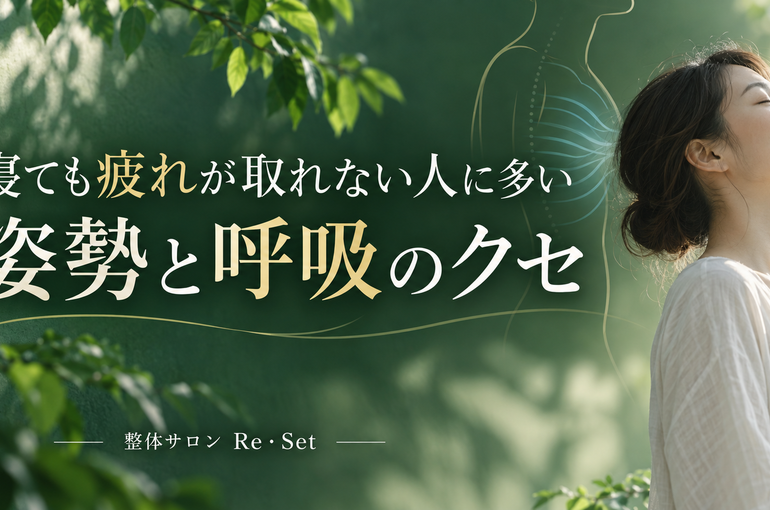
Common postures and breathing habits of people who don't feel rested even after sleeping.
"I slept well, but my body feels heavy this morning."
"My neck and shoulders are stiff from the moment I wake up."
"Even after resting, I don't feel like the fatigue has gone away."
These kinds of problems can be related not only to the amount of sleep you get, but also to your posture and breathing patterns during the day.
The reason why you don't feel rested even after sleeping isn't solely due to the amount of sleep you get.
Besides lack of sleep, various other factors can contribute to persistent fatigue, including lifestyle imbalances, stress, lack of exercise, and illness.
Among these, a common condition observed in chiropractic practice is that the body remains tense and breathing becomes shallow.
Those who spend long hours working at a desk or looking at their smartphones tend to jut their heads forward, hunch their backs, and have reduced movement in their chest and rib cage.
Three common characteristics of people who have difficulty recovering from fatigue
1. The head is jutting forward and the back is rounded.
In a posture where the head is jutting forward, the muscles in the neck and shoulders have to constantly support the head.
Therefore, even when you think you are resting, it becomes difficult to release tension in your neck, shoulders, and back. Also, a hunched-over posture makes it difficult to expand your chest, and breathing tends to become shallower.
Several studies have reported a correlation between forward head posture, hunched posture, and changes in respiratory function. However, posture alone does not determine fatigue or sleep quality.
2. Breathing with shoulders raised
If your shoulders move up and down significantly with each breath, you may be tensing the muscles around your chest and neck too much.
Normally, the rib cage and abdomen move naturally, but when the body is tense, breathing tends to be concentrated in the upper chest.
If this condition persists, your neck and shoulders may not get enough rest, and you may feel that your shoulders are heavy even after sleeping or that your neck is stiff from the moment you wake up.
3. Not exhaling completely.
People who are tired often focus too much on the act of "inhaling."
However, when regulating your breathing, it's important to first exhale slowly without straining. If you have a habit of holding your breath or breathing quickly and shallowly, it becomes difficult to relax your body.
First, a quick check to verify
- When sitting, my head juts forward.
- When I try to straighten my chest, my lower back arches.
- When I take a deep breath, my shoulders rise.
- When I inhale, my chest and sides don't expand easily.
- My neck, shoulders, and back have been heavy since this morning.
- They often clench their teeth.
If several of these apply to you, it may be because your posture or breathing habits are making it difficult to release tension in your body.
Three self-care routines you can do before bed
1. Long exhalation
Lie on your back with your knees bent and breathe in gently through your nose. Next, exhale slowly and steadily through your mouth.
Perform this exercise for about 5 breaths, without tensing your shoulders. If you feel discomfort or shortness of breath, stop immediately.
2. Gently stretch the front of your chest.
Place your hands on the wall or door frame and slowly turn your body to the other side.
Hold this position for about 20 seconds, feeling a comfortable stretch from your chest to the front of your shoulders. Aim to do this twice on each side.
3. Slowly move your back.
Get on all fours, exhale and round your back, then inhale and return to the starting position as far as you comfortably can.
There's no need to arch your back too much. Do it slowly 5 to 10 times, coordinating with your breath.
Re-Set checks the overall condition of the body.
At Re・Set, a chiropractic salon near Hashimoto Station, we don't just focus on relieving the painful areas; we also check the following points.
- Head and shoulder position
- Movement of the shoulder blades and back
- Stiffness around the rib cage and ribs
- Pelvic and hip joint balance
- Body movements when breathing
We provide treatments tailored to each individual's condition, helping to reset your tired mind and body and prepare your body for tomorrow.
"Even after sleeping, I still feel tired."
"My neck and shoulders feel heavy since this morning."
"I feel like it's difficult to take a deep breath."
If you're experiencing these symptoms, why not take some time to check your posture and breathing habits?
*If you experience severe snoring, sleep apnea, unbearable daytime sleepiness, shortness of breath, or prolonged, intense fatigue, please consult a medical professional rather than relying solely on chiropractic treatment.