What causes back pain from long journeys during holidays? What can you do to prevent it when traveling by car or train?
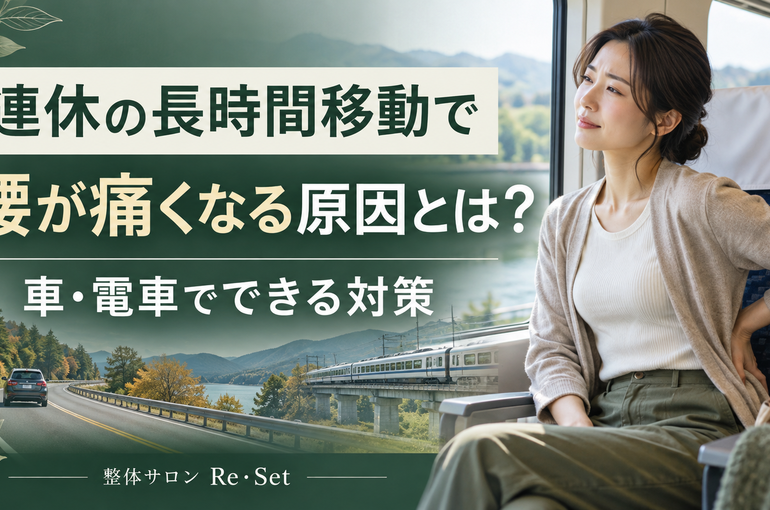
What causes back pain from long journeys during holidays? What can you do to prevent it when traveling by car or train?
During long holidays like Silver Week, people tend to spend more time traveling by car or train for extended periods, whether it's visiting family or going on vacation.
"My legs started feeling heavy while I was traveling."
"When I arrive at my destination and stand up, my back doesn't straighten."
"The stiffness in my lower back lingered until the next morning."
These symptoms may be caused by prolonged sitting, which reduces movement around the lower back and hip joints, leading to concentrated strain on those areas.
This time, we'll discuss why long journeys often cause lower back pain and introduce some countermeasures you can implement when traveling by car or train.
Main reasons why sitting for long periods of time causes back pain
1. Maintaining the same posture for a long time
Sitting may seem comfortable, but the muscles in your lower back and spine are constantly working to support your body.
The longer you maintain the same posture, the less you move your body, and the more likely you are to feel tension and heaviness in your lower back and hips.
Rather than trying to "maintain good posture without ever losing it," it's more important to change your posture within a comfortable range.
2. The pelvis tilts backward, and the back becomes rounded.
Sitting shallowly on a car or train seat can cause your pelvis to tilt backward and your back to hunch.
If you continue to look at your smartphone in that position, your head will also jut forward, putting strain not only on your lower back but also on your neck and shoulders.
3. The hip joints and buttocks become immobile.
While sitting, your hips remain bent. Because the muscles in your buttocks and thighs hardly move, you may find it difficult to straighten your lower back when you stand up.
4. Vibrations and tension while driving
When driving a car, in addition to vibrations from the road surface, your body tenses up due to steering and pedal operation.
When driving in traffic or on unfamiliar roads, you may unconsciously tense your shoulders and lower back, leading to increased fatigue from sitting.
Back pain prevention when traveling by car
Adjust the seat to fit your body.
Sit back in the seat and lean your body against the backrest.
Adjust the seat so that your knees are not fully extended when you press the pedals, and your shoulders are not too far away from the backrest when you hold the handlebars.
If there is a gap between your lower back and the backrest, placing a thinly folded towel near the waist belt will help support your posture. Be careful not to use a cushion that is too thick, as this may cause your lower back to arch.
Take a break in a safe place.
If possible, change your posture every 30 to 60 minutes and get out of the car in a safe place such as a service area.
Even just a few minutes of walking can help loosen stiff lower back and hip joints. It's dangerous to stretch while driving, so be sure to pull over before doing so.
Remedies to combat fatigue from sitting on the train
While being mindful of those around you, perform the following small exercises:
- Slowly raise and lower your heels.
- Move your ankles by raising and lowering your toes.
- Gently straighten one leg at a time.
Move your pelvis slightly back and forth.
Stand up when it is safe, such as when the vehicle is stopped.
You don't need to move around a lot. The key is to avoid staying in the same position for long periods of time.
Recommended care upon arrival
Once you arrive at your destination, instead of immediately lying down, try walking around a bit at a comfortable pace first.
Afterward, gently stretch your hips and buttocks without twisting your waist too much. There's no need to endure pain, use momentum, or force your lower back to arch.
When lifting heavy objects, keep them close to your body and use your knees as well as your waist, not just your hips. Avoid twisting your body while lifting.
If you experience these symptoms, please consult a medical professional.
If you experience any of the following symptoms, please consult a medical professional rather than relying solely on chiropractic treatment.
- There is severe numbness or weakness in the legs.
- Abnormalities in urination or defecation
- Pain started after a fall or accident.
- accompanied by fever
- Severe pain persists even at rest.
• Symptoms are worsening over time.
We will check the condition of your entire body, not just your lower back.
Lower back pain after long journeys can be related not only to how you sit, but also to hip joint stiffness, back movement, and your usual posture.
At Hashimoto's chiropractic salon, Re・Set, we don't just strongly massage the lower back; we check your posture, pelvis, hip joints, and back movement, and propose treatments and self-care methods tailored to each individual's condition.
If you're experiencing persistent lower back stiffness or tightness after traveling during the long holiday weekend, please consult us before enduring the discomfort any longer.
Related articles:
Regarding buttock pain while driving
reference:
Ministry of Health, Labour and Welfare, "Guidelines for Physical Activity and Exercise for Health Promotion 2023"
Ministry of Health, Labour and Welfare "Active Guide 2023"