What is the shoulder girdle? The position and function of the scapula and clavicle | Also explaining its relationship to stiff shoulders.
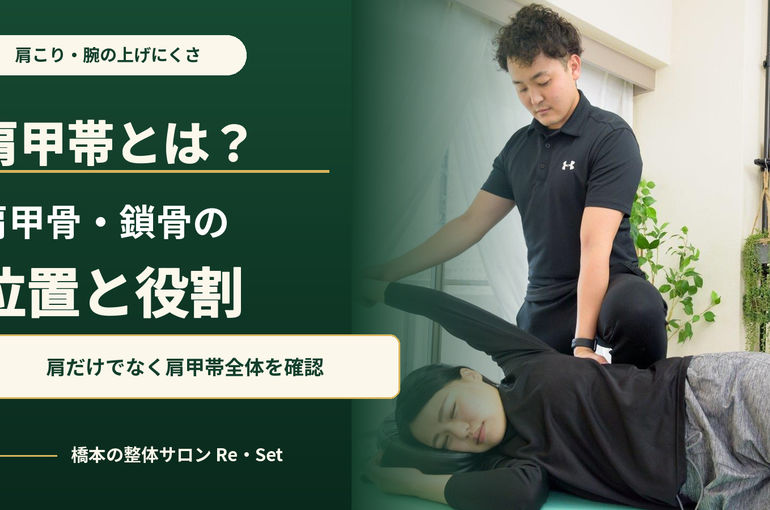
The shoulder girdle is the area connecting the arm and torso, centered around the shoulder blade and collarbone. Hashimoto's chiropractic salon Re・Set explains the relationship between the shoulder girdle and shoulder stiffness and difficulty raising the arms, as well as points to reconsider in daily life.
"I've heard the term 'scapula,' but I don't know which part it is."
"Even though I'm moving my shoulder blades, my shoulder stiffness isn't getting any better."
Do you have any of these concerns?
The shoulder girdle is a crucial part of the body, primarily composed of the scapula and clavicle, connecting the arm to the torso. When the movement of the shoulder girdle is restricted, strain tends to concentrate on the muscles of the shoulders and neck.
In this article, Hashimoto's chiropractic salon, Re・Set, will provide a clear explanation of the position and function of the shoulder girdle and its relationship to shoulder stiffness.
What is the shoulder girdle?
The shoulder girdle is the part that connects the arm to the torso, and is mainly composed of the "scapula" and "clavicle."
When you raise your arm, pull it back, or pick up an object, not only your arm but also your shoulder blades and collarbone move together.
Therefore, when the movement of the shoulder girdle is reduced, the muscles of the arms and shoulders have to compensate for the movement, which puts a strain on the neck and shoulders.
The position and function of the scapula
The scapula is a flat bone located on the upper back, one on each side.
It moves as if gliding over the ribs, moving up and down, inward and outward, and in rotational directions in accordance with the movement of the arms.
Many muscles that connect to the neck, shoulders, back, and arms attach to the shoulder blades. Therefore, the position and movement of the shoulder blades are related to shoulder stiffness and posture.
Repeatedly using your arms with limited shoulder blade movement can easily lead to increased strain on the muscles around the shoulders.
The role of the clavicle
The clavicle is the bone that connects the sternum (sternum) in the center of the chest to the scapula (shoulder blade).
When you raise your arms, not only your shoulder blades but also your collarbones rotate and lift.
When you hunch your back while doing desk work or using your smartphone, your shoulders tend to roll forward, and the movement around your collarbone also tends to decrease.
It's not enough to just move the shoulder blades; it's important to check the movement of the entire shoulder girdle, including the clavicle and rib cage.
Causes of restricted shoulder girdle movement
The following lifestyle habits may be contributing to reduced shoulder girdle movement:
• Long hours of desk work
• Spending long periods of time looking at smartphones
- You have a hunched back or rounded shoulders for an extended period.
- Using only one hand
- Lack of exercise means fewer opportunities to move your arms widely.
- Breathing becomes shallow due to tension or fatigue.
When you maintain the same posture for extended periods, your shoulder blades and collarbones tend to stay in a fixed position.
Even if your shoulders feel lighter immediately after a massage, if your posture at work or in your daily life doesn't change, the strain on your shoulders may return.
Relationship with stiff shoulders
If the movement of the shoulder girdle is limited, the muscles in the neck and shoulders tend to work more than necessary when raising or extending the arms forward.
In particular, computer work and smartphone use involve maintaining a posture with your arms extended forward for extended periods.
In this posture, the shoulders tend to roll forward, and you may feel tension, heaviness, or dullness in the neck, shoulders, and around the shoulder blades.
If you experience recurring shoulder stiffness, it's important to check not only the painful area, but also your shoulder blades, collarbone, back, and even your breathing movements.
A simple way to check the movement of the shoulder girdle
Let's compare the following movements on the left and right sides.
Can you raise both arms to the sides of your ears?
- Do your shoulders shrug when you raise your arms?
- Check if there is any difference between the left and right sides when you reach behind your back.
- When you try to straighten your chest, are you only arching your lower back?
- Do your chest and rib cage expand when you take a deep breath?
There is no need to endure the pain and move.
If you experience severe pain, numbness in your arm, weakness, or pain that persists even at night, please do not force yourself to exercise and consult a medical professional.
Re-Set checks not only shoulder movement but also the movement of the entire body.
At Re・Set Hashimoto, a chiropractic salon, we don't just treat the shoulders if you have shoulder stiffness.
In addition to checking the movement of the shoulder blades and collarbones, we also examine the condition of the neck, back, rib cage, and pelvis, as well as the movement when raising the arms.
We will massage your muscles according to your physical condition, adjust the balance of your shoulder blades and entire body, and teach you simple self-care techniques that you can do at home as needed.
"Even if I massage my shoulders, they go back to normal immediately."
"It's difficult to raise my arms."
"My shoulder blades always feel heavy."
If you have any of these concerns, please feel free to contact Re・Set, a chiropractic salon in Hashimoto.
In a tranquil, private room, we will propose a treatment tailored to your physical condition.