What are the adductor muscles? A chiropractor explains their location, function, and relationship to posture and gait.
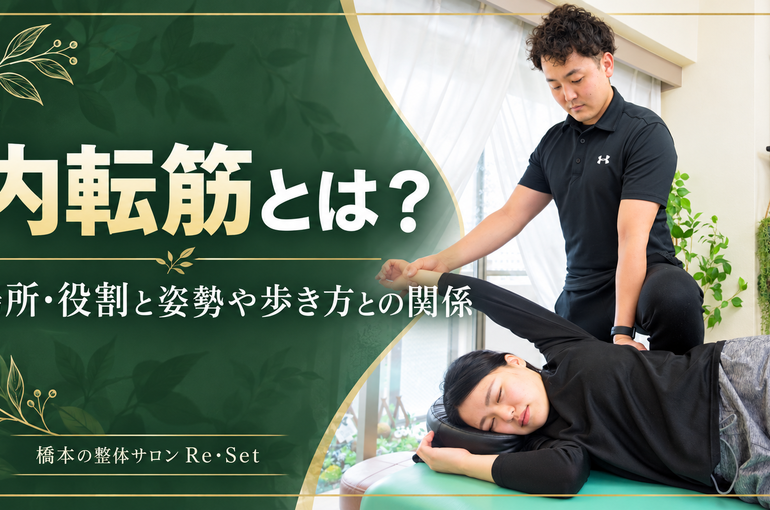
The adductor muscles are a group of muscles located on the inner thigh. In addition to their location and function, a chiropractor from Hashimoto's chiropractic salon Re・Set will explain the effects of stiffness and weakness on posture and gait, as well as self-checks you can do at home.
The adductor muscles are a collective term for the muscles of the inner thigh that extend from the pelvis to the inside of the thigh. They are involved not only in closing the legs but also in flexing and extending the hip joint and in stabilizing the body when standing and walking.
- My inner thighs are stiff and it's difficult to spread my legs.
- Walking makes my hip joints and inner thighs tired.
- When standing, it's easy to put your weight on one leg.
These kinds of physical habits may be related to the adductor muscles.
In this article, a chiropractor from the Re・Set chiropractic salon in Hashimoto explains the location and function of the adductor muscles, their relationship to posture and walking style, and how to perform a self-check at home.
Where are the adductor muscles located? The five muscles on the inner thigh.
The adductor muscles are a group of muscles that run from the pelvis (pubic bone and ischium) to the inner thigh. The so-called "inner thigh muscles" are mainly composed of the following five:
- Adductor magnus: The largest of the adductor muscles, it is attached broadly from deep inside to the back of the thigh.
- Adductor longus muscle: Located on the front of the inner thigh. Easily felt near the groin when the legs are spread apart.
- Adductor brevis: A short muscle located beneath the adductor longus.
- Pectineus muscle: The uppermost muscle among the adductor muscles, located near the base of the leg (groin).
- Gracilis muscle: A long, slender muscle that runs along the innermost part of the inner thigh and extends to the inside of the knee.
Most muscles attach from the pelvis to the femur, but the gracilis muscle extends to the inside of the knee. Therefore, it is involved in the movement of the knee as well as the hip joint.
According to documents from the Ministry of Health, Labour and Welfare, the adductor magnus, adductor longus, adductor brevis, pectineus, and gracilis muscles are involved in the adduction movement of the hip joint.
Source: Ministry of Health, Labour and Welfare, "4-4 Muscles that are active during physical exercise" (PDF)
Main role of the adductor muscles
1. Move your legs inward.
The basic function of the adductor muscles is to bring the legs that have turned outward back towards the center of the body.
It helps prevent your legs from spreading too far apart when you stand up from a chair or walk.
2. Assists with flexion and extension of the hip joint.
The adductor muscles are not just for "closing the legs."
The adductor longus muscle, for example, assists in hip flexion, while a portion of the adductor magnus muscle is also involved in hip extension. A key characteristic is that the role of each muscle changes depending on the type of muscle and the angle of the hip joint.
3. Stabilize the pelvis and hip joints.
When standing on one leg, the muscles on the outside of the buttocks and the adductor muscles work together to stabilize the pelvis and hip joint.
This function is related to posture when standing and weight transfer when walking.
The relationship between adductor muscles and posture
When standing or sitting, the adductor muscles help maintain the position of the legs and stabilize the area around the pelvis.
If the adductor muscles don't function properly, or if there's a difference in stiffness between the left and right sides, it can lead to the following postural habits.
- I often stand with my weight on one leg.
- When standing, your knees and toes tend to point inward.
- When I sit down, my knees spread apart, and I feel like crossing my legs.
- Standing with your pelvis tilted to one side or the other
Conversely, maintaining this posture for extended periods can lead to imbalances in how the adductor muscles are used on the left and right sides of the body.
However, postural habits are not determined solely by the adductor muscles. It is important to check them in conjunction with the gluteal muscles, core muscles, and ankle movement.
The relationship between adductor muscles and walking style
When walking, you shift your weight alternately between your left and right legs.
The adductor muscles stabilize the femur and pelvic area of the leg that is on the ground, supporting the movement of shifting weight to the next step. Studies have reported that in single-leg support, the adductor muscles are involved in moving the pelvis towards the supporting leg and bringing the femur closer to vertical.
Source: "Internal hip abduction moment and muscle activity patterns of hip adductor and abductor muscles during single-leg standing" (Physical Therapy Supplement, J-STAGE)
If you have difficulty using your adductor muscles effectively, you may notice the following characteristics in your gait:
- My body sways from side to side while walking.
- Standing on one leg becomes unstable.
- It is difficult to move the legs straight forward.
- My knees wobble when I go up stairs or stand up.
- My buttocks and the outer thighs get tired easily.
Additionally, tight adductor muscles can cause tightness in the inner thighs and groin area when widening your stride.
However, conditions such as "knees turning inward" or "body swaying when walking" are not determined solely by the adductor muscles. It is important to examine the function of the adductor muscles, glutes, trunk, and feet together.
Body habits often seen in people with tight adductor muscles
- It's difficult to sit cross-legged or do the splits.
- My inner thighs and groin feel tight.
- I feel uncomfortable when I widen my stride.
- Difficulty opening the hip joint outwards
- It is easy to put weight on one hip joint.
These issues are not necessarily caused solely by the adductor muscles.
The muscles in your glutes, the range of motion in your hip joints, the movement of your ankles, and how you use your pelvis and core are all related. It's important not to assume that "if your inner thighs are tight, you only need to stretch your adductor muscles."
Easy self-check of adductor muscles
Sit lightly on a chair and place a cushion or rolled-up towel between your knees. While doing this, try gently closing your knees together without holding your breath.
Please check the following points.
- Is there a difference in how much force is applied between the left and right sides?
- Are you putting strain on your hips or shoulders instead of your inner thighs?
- Do you experience any pain in your groin or knees?
- Can't exert force without holding your breath?
This is only a basic check. If you experience any difference between the left and right sides or pain, do not continue to apply force.
Simple adductor muscle exercises you can do at home
Towel-holding exercise
- Sit in a chair and place a rolled-up towel between your knees.
- Keep your back straight and your feet flat on the floor.
- Lightly place a towel between your arms while exhaling.
- Hold for 3 seconds, then release the tension.
- Repeat 5 to 10 times.
There's no need to squeeze hard. Just a light pressure on your inner thighs is enough.
If you experience pain or severe discomfort in your groin area, discontinue use.
Related article: Why do my thighs hurt or feel tight when I sit in the seiza position? For those who have difficulty bending their knees.
At Hashimoto's chiropractic salon Re・Set, we don't just focus on the inner thighs.
At Hashimoto's chiropractic salon Re・Set, we don't just treat the adductor muscles, even if you have discomfort in your inner thighs or hip joints.
- Hip joint flexion and extension
- Movements of the pelvis and trunk
- The function of the gluteal muscles
- Direction of the knees and ankles
- Standing on one leg and walking
- Sitting and standing postures in daily life
We examine these factors and search for the reason why the burden is concentrated in one area of the body.
After adjusting the movement of your muscles and joints through treatment, we will teach you one or two types of exercises that are easy to continue at home, as needed.
If the pain is severe, go to a medical institution.
If you experience any of the following symptoms, please consult a medical professional such as an orthopedic surgeon before continuing with self-care or chiropractic treatment.
- Severe pain after a fall or sports activity
- My groin and thighs are swollen.
- Unable to put weight on my feet
- The pain is severe even when at rest.
- There is numbness and difficulty applying force.
- The pain has been going on for a long time.
Hip joint disorders can also cause pain and difficulty moving while walking. It's important not to self-diagnose and assume it's "just muscle stiffness."
summary
The adductor muscles are a collective term for the muscles on the inside of the thigh. They are involved not only in closing the legs but also in flexing and extending the hip joint, maintaining posture while standing, and stabilizing while walking.
Even if you experience tightness or difficulty using your inner thighs, the cause isn't necessarily limited to the adductor muscles. It's important to check the movement of your entire body, including your hips, pelvis, buttocks, knees, and ankles.
If you are concerned about tightness in your inner thighs, difficulty moving your hip joints, or differences in posture or gait between the left and right sides of your body, please feel free to contact Re・Set, a chiropractic salon in Hashimoto.
Re・Set Chiropractic Salon, Hashimoto Branch
Primrose House, Rooms 303 and 305, 3-19-17 Hashimoto, Midori-ku, Sagamihara City, Kanagawa Prefecture
Phone: 042-703-3066
https://seitai-reset.net/
Our goal is not just temporary changes, but to create a body that can be balanced through treatment and maintained in good condition through necessary exercise.